Unrivaled Precision. Unquestionable Results. Your Science, Verified.
We provide standalone analytical services for teams that already have material and need reliable third-party data.
.svg)
ANALYTICAL SERVICES
Thermogravimetry (TGA)
Thermal analysis is a foundational technique in our projects. Coupled with cyclic adsorption/regeneration, it reveals a sorbent’s capacity and durability in operation.
We also offer stand-alone thermogravimetric analysis (TGA) as a service, for samples heated under N2, air or other gases. From EUR 200 per sample.
.svg)
TGA is useful for assessing thermal stability, mass loss, solvent removal, activation state, and durability under realistic operating conditions.
Thermogravimetric analysis measures how a sample’s mass changes as it is heated under a controlled gas atmosphere, shows when volatile components leave, when the material activates, and when thermal decomposition begins. The output usually includes the raw mass-loss curve, derivative features, key transition temperatures, and a short interpretation of what those changes likely represent. The typical sample requirement for TGA is around 100 mg.
ANALYTICAL SERVICES
Gas adsorption
PROFMOF is equipped to collect adsorption data with gases and volatile liquids, and adsorption analysis is a core characterization technique in all projects involving MOFs and other porous materials. We also offer adsorption isotherms for N2, CO2, H2O (and others on request), from EUR 500 per sample.
%20g-1%20outlined.svg)
Adsorption isotherms measure how much gas or vapor a material takes up at controlled pressure and temperature.
The sample is exposed stepwise to an adsorbate while uptake is recorded across the full pressure range. This provides valuable information of the material’s affinity to the adsorbate, capacity as a function of pressure, along with derived metrics such as surface area and pore volume. You receive raw and processed data, key metrics, and concise interpretation notes. The typical sample requirement is around 500 mg.
ANALYTICAL SERVICES
Dynamic breakthrough analysis
This technique is used to evaluate the effective sorption capacity of adsorbents under continuous flow conditions and realistic process environments. We perform cyclic breakthrough/regeneration measurements to closely emulate a real process.
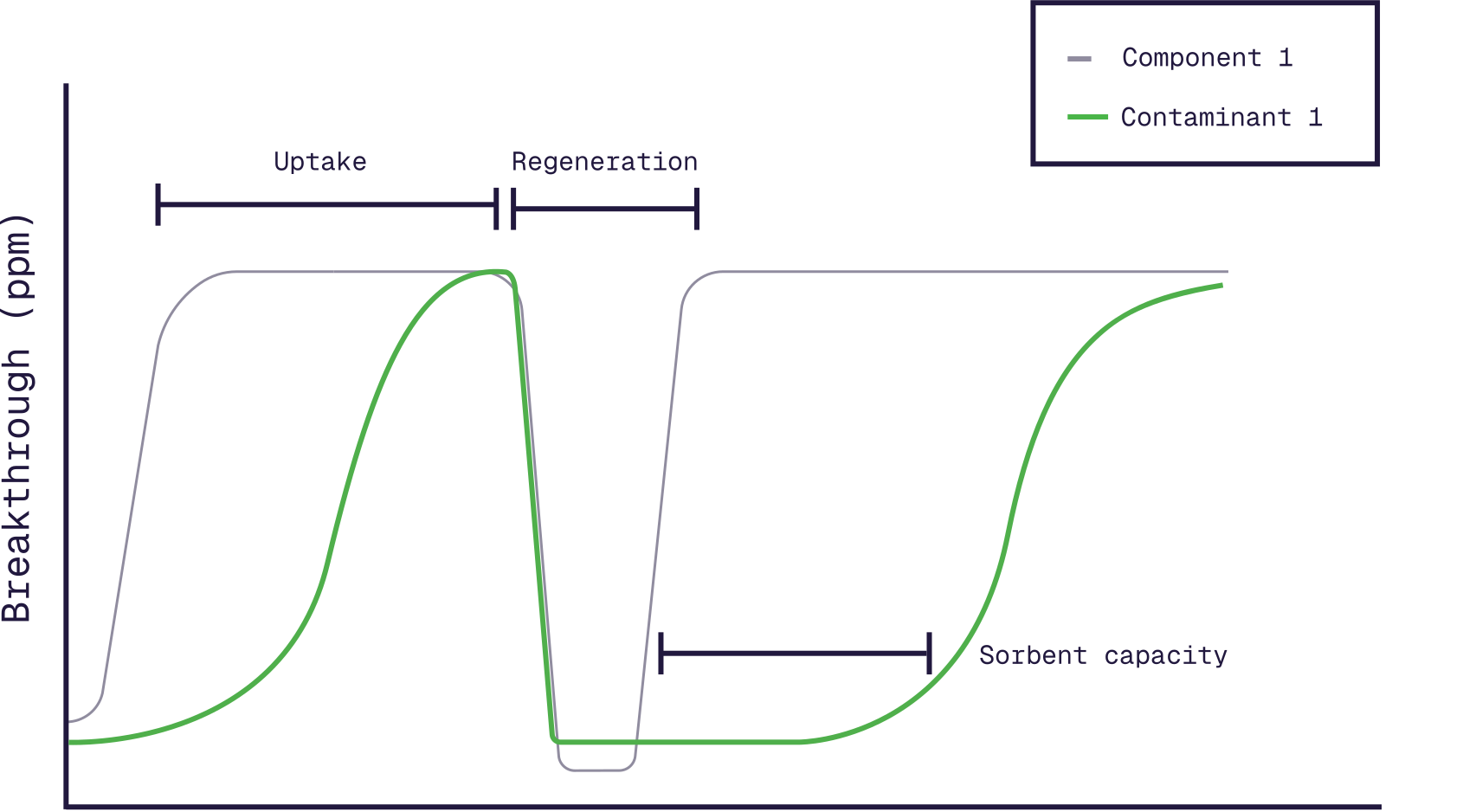
Our breakthrough analysis rigs are lab-scale approximations to industrial scrubbers, polishers or separation units.
A packed bed is loaded with the test material, then exposed to a gas mixture with controlled composition, temperature, pressure, and flow rate. The outlet stream is monitored over time to see when each component starts to appear downstream. This produces a breakthrough curve, which shows the dynamic uptake behavior of the bed under realistic conditions rather than ideal equilibrium only.